
Baby Habit Tracking: From Parent-Led Routines to Toddler Independence
Learn how our innovative habit tracking feature evolves with your child from newborn to toddler, supporting the Double-Loop theory of habit formation that reduces parental cognitive load while building your child's self-regulation skills.
What if your baby tracking app could do more than just log feeds and diapers? What if it could actually help your child develop lifelong healthy habits while making your parenting journey easier?
At BabyEase, we've reimagined habit tracking from the ground up. Our new Habit & Behavior Feature isn't just another checklist – it's a behavioral coaching system that evolves with your child from newborn to toddler, supporting both you and your little one at every developmental stage.
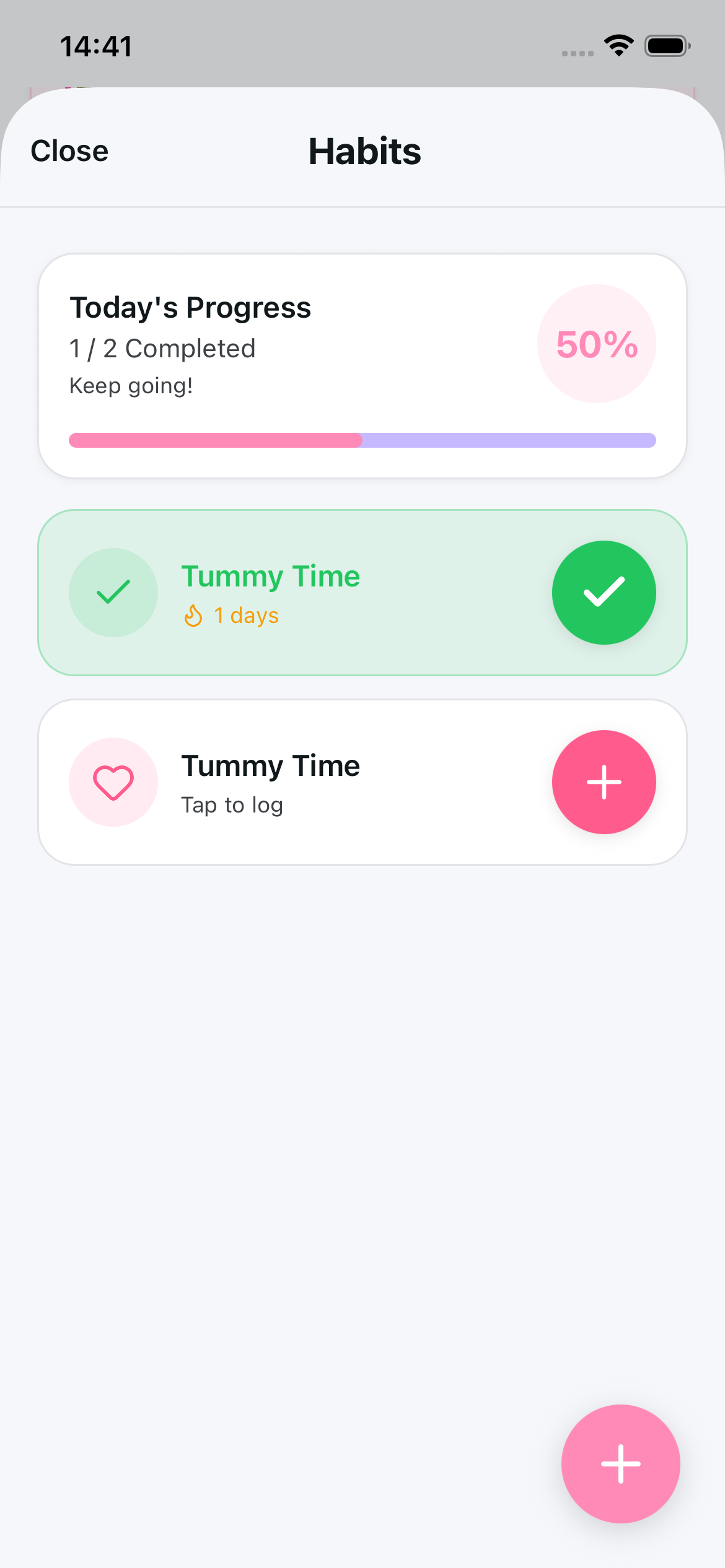
#The Problem with Traditional Baby Trackers
For over a decade, baby tracking apps have focused on one thing: recording biological inputs and outputs. Breastfeeding duration, formula volume, sleep intervals, diaper contents. While these metrics are valuable, they only tell you what happened – not what should happen next.
Traditional trackers treat habit formation as a static checklist. But here's the truth: a habit for a 2-month-old looks completely different from a habit for a 2-year-old. And the user of the app changes too – from a sleep-deprived parent managing an infant's biological rhythms to a toddler who wants to press the buttons themselves.
#The Dual-User Challenge: Designing for Two
What makes habit tracking for babies unique is the dual-user challenge. We're not designing for one user – we're designing for two:
#The Parent User (0-18 months)
- Sleep-deprived adults seeking efficiency
- Need data clarity and reassurance
- View habit formation as project management
- Primary goal: Establish consistency to regulate baby's rhythms
#The Child User (18-36 months)
- Emerging autonomy and "I do it myself!" attitude
- Need gamified, sensory-rich experiences
- Learning through imitation and participation
- Primary goal: Build self-regulation and independence
Our solution? A Kid Mode toggle that transforms the interface from a data-rich parent dashboard to a bright, simplified playground for toddlers – complete with parent gates to prevent accidental data deletion.
#The Double-Loop Theory: Two Habits, One System
At the heart of our feature is what we call the Double-Loop Theory of habit formation. We're not just building one habit loop – we're building two interlocking loops that support each other:
#Loop 1: The Parent Loop (Efficiency & Reassurance)
| Stage | What Happens |
|---|---|
| Cue | Push notification ("Nap time in 15 mins") or environmental trigger |
| Routine | Performing care task and logging it in app |
| Reward | Data visualization (streaks), reduced mental load, encouraging feedback |
| Goal | Reduce decision fatigue and maintain consistency |
#Loop 2: The Child Loop (Development & Autonomy)
| Stage | What Happens |
|---|---|
| Cue | Visual prompt from app or auditory cue (cleanup song) |
| Routine | Physical act (brushing teeth, putting on pajamas) |
| Reward | Digital feedback (animation, sound) + parental praise |
| Goal | Internalize routine until it works without digital help |
The key insight: The app's success depends on reducing friction in the Parent Loop so parents have the emotional energy to facilitate the Child Loop. If the app is cumbersome, parents abandon logging, and the entire structure for the child collapses.
#Feature Breakdown by Age
#Newborn Phase (0-3 Months): The Consistency Engine
During the "fourth trimester," babies lack a developed circadian rhythm. At this stage, we focus on parental adherence to soothing rituals, not baby outcomes.
The Rhythm Builder Module:
- Tracks "Wake Windows" rather than rigid clock times
- Shifts the entire day's schedule automatically when baby wakes early
- Provides context-aware reminders: "Leo has been awake for 90 minutes. Start the wind-down routine now."
Sleep Hygiene Tracking: Rather than tracking if the baby "chose" to sleep, we track if you executed the sleep hygiene routine:
- Swaddling ✓
- White noise on ✓
- Lights dimmed ✓
This shifts success metrics from unpredictable outcomes to controllable inputs – reducing parental anxiety.
#Infant Phase (4-12 Months): The Gamified Coach
As motor skills develop, new routines emerge. Tummy time becomes the first real "chore" of infancy – developmentally critical but often dreaded.
Tummy Time Tracker:
- High-contrast visual patterns on screen to hold baby's attention
- Audio guides for parents suggesting different positions
- "Strength Graph" showing cumulative progress
- Milestones like "First Head Lift" and "First Roll"
Interaction Habits: By 6-12 months, we introduce enrichment activities:
- "Read a Book" linked to bedtime bottle (habit stacking)
- "Play Peek-a-Boo" as serve-and-return practice
- Sign language practice tracking
#Early Toddler Phase (12-24 Months): Parallel Participation
The toddler enters the "I do it!" phase. They crave predictability and want to imitate adults. Our app supports Parallel Participation – the parent logs, but the child performs.
The Cleanup Habit:
- Plays a specific "Cleanup Song" as an auditory cue
- Toddler learns: when the music plays, it's time to put blocks away
- Habit forms through consistent pairing of sound + action
Visual Schedule Timeline:
- Horizontal timeline of icons (Sun → Bowl → Toothbrush → Bear)
- Helps toddlers understand "what comes next"
- Reduces transition anxiety and tantrums
#Late Toddler Phase (24-36 Months): The Interactive Playground
Now the child can interact directly with the device. The app provides Digital Agency – pressing a big, colorful button to confirm they brushed their teeth.
The Potty Pal Module:
- Playful timer with funny sounds (quack, whistle, giggle)
- Differentiates "Sitting" (trying) from "Going" (success)
- Rewards effort, not just biological results
- Pattern analysis for parents: "Accidents happen mostly at 4 PM"
The Brush Monster:
- AR mode overlays "digital germs" on child's camera reflection
- Brushing "wipes away" the germs on screen
- 2-minute song acts as timer and distraction
- Character "levels up" with consistent brushing
#Psychology-Backed Design
#Positive Reinforcement & The Praise Prompter
Research shows positive reinforcement is more effective than punishment for young children. But tired parents often default to "management by exception" – only reacting to bad behavior.
Our app acts as a Praise Prompter. When a habit is completed, it displays:
"Tell Leo: 'I love how you put the red blocks in the box! You are such a great helper!'"
This helps parents deliver specific, labeled praise (praising the effort/action) rather than generic praise ("Good boy"), which fosters a Growth Mindset.
#Self-Determination Theory: Autonomy, Competence, Relatedness
Long-term habit adherence comes from satisfying three psychological needs:
| Need | How We Support It |
|---|---|
| Autonomy | Toddlers make choices within routines (Apple vs Banana for snack) |
| Competence | Big buttons, clear feedback, error tolerance – kids feel "I did it!" |
| Relatedness | "Dual-Mode" visualization where parent and child avatars brush side-by-side |
#UX Design: Thumb Zone Meets Toddler Touch
We designed for both user types simultaneously:
#For Tired Parents (The Thumb Zone)
- All primary actions in bottom third of screen
- Swipe gestures for quick logging while walking a crying baby
- Haptic feedback confirms actions without looking
- True Dark Mode with optional "Red Light Mode" for night feeds
- Voice activation via Siri/Google Assistant
#For Toddlers (The Toddler Touch Standard)
- Touch targets minimum 96x96 pixels (2x adult standard)
- "Kid Mode" sandbox with parent gate to exit
- No text dependence – skeuomorphic icons only
- Forgiving gestures (simple taps and broad swipes only)
- Immediate feedback (
<100mslatency) connecting action to result
#The Reward System: Beyond Sticker Charts
We take a playful design approach rather than "casino mechanics":
#Virtual Sticker Book
- Children earn stickers of animals, vehicles, plants
- They don't just receive rewards – they use them
- Drag and drop stickers to create scenes (cow in barn, fish in pond)
- Engages creativity and extends learning
#Narrative Progress
- "Sleepy Train" visualization for bedtime routine
- Each completed task (Bath → PJs → Book) moves train to next station
- Story structure gives meaning to individual steps
#No Loss Mechanics
- Missed days are blank spaces, never red X's or broken chains
- "That's okay! We can try again tomorrow."
- Models resilience and self-compassion
#Data Intelligence: From Tracking to Predicting
Our habit feature doesn't just track – it predicts:
#Behavioral Readiness Predictions
- Potty Prediction: Based on fluid intake and past patterns, predict when toddler likely needs the potty
- Meltdown Prevention: Analyze sleep debt, time-since-feed, and activity to warn of "Meltdown Hazard"
#Dynamic Habit Suggestions
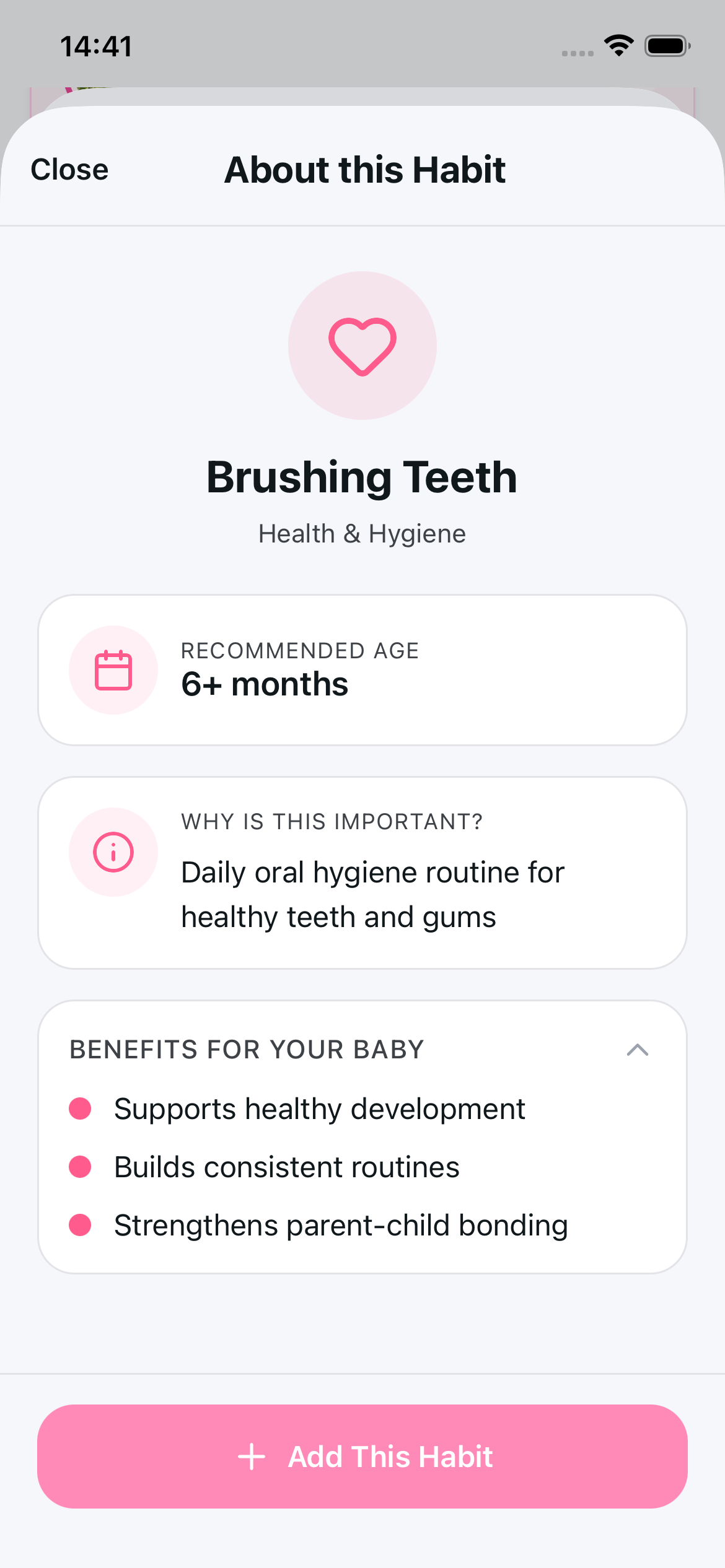
Our app suggests age-appropriate habits based on your baby's developmental stage. Each habit includes recommended ages, importance explanations, and specific benefits for your child.
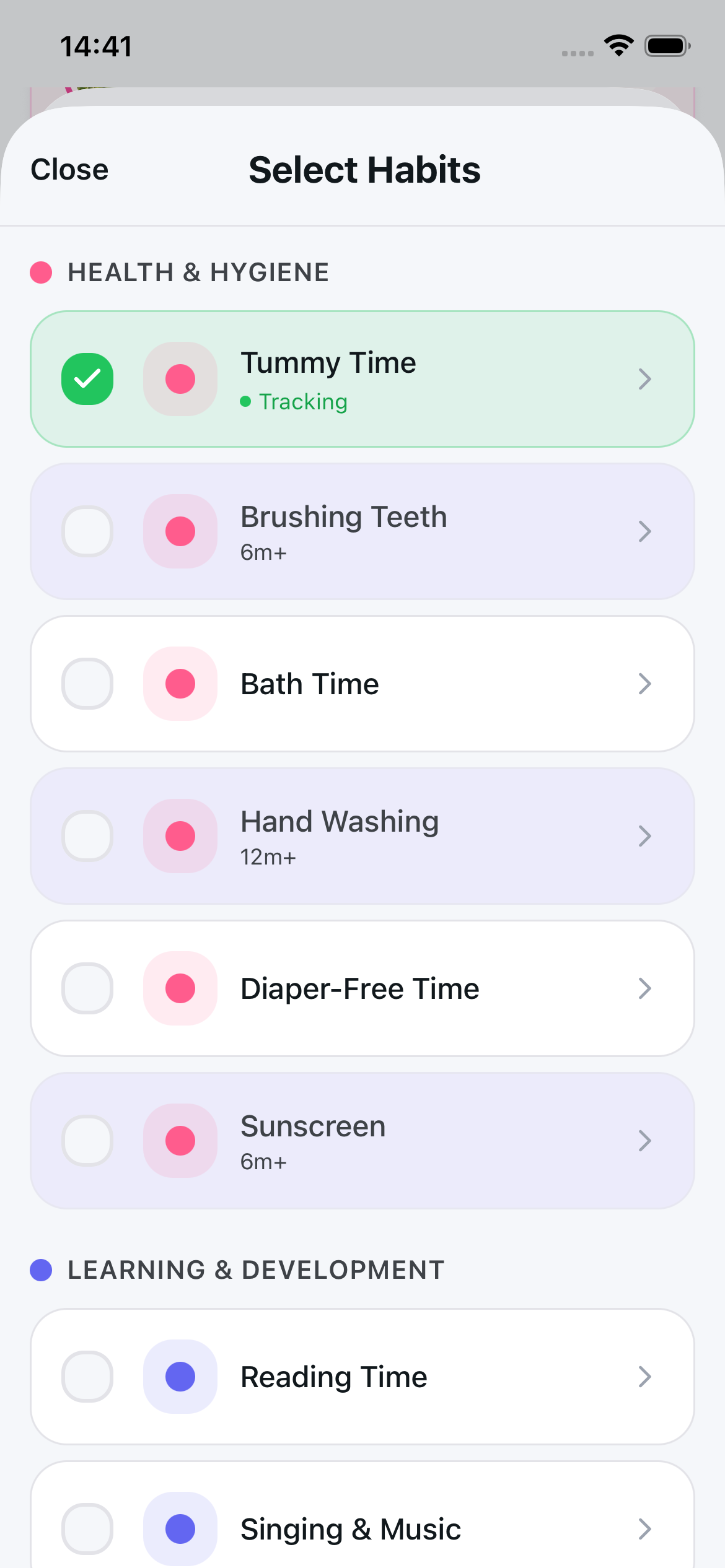
When you tap on any habit, you'll see detailed information about why it matters and how it supports your baby's development:
- At 6 months: Suggest "Solids" and "High Chair Time"
- At 18 months: Suggest "Hand Washing" and "Putting Toys Away"
- After "First Steps" logged: Unlock gross motor habits and safety reminders
#Try the Habit Feature Today
Our Habit & Behavior Feature transforms your smartphone from a distraction into a developmental partner. The metric of success isn't "time in app" – it's the quality of time out of the app.
If the feature helps you establish a calm bedtime routine, resulting in 20 minutes of extra sleep for your family, it has delivered profound value. This is technology in service of biology – a digital habit that nurtures a human one.
Download BabyEase – and discover how effortless habit building can be for your growing family.
The habit tracking feature is informed by research from developmental psychology, behavioral economics, and Montessori educational principles. See our full research documentation for citations and methodology.